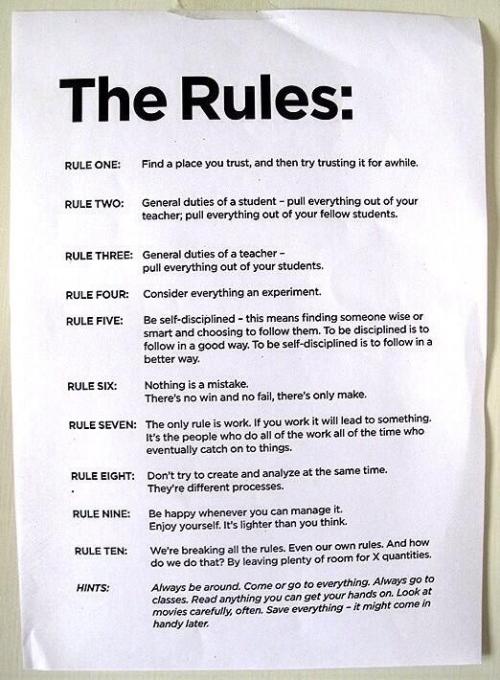
 I chanced upon “The Rules” again yesterday. They’re the ones attributed to John Cage, one of the most influential American composers and pedagogues of the 20th century. Many of his works disrupted the way we think about listening. To Cage, music was everywhere and could be made with anything. Chance plays a big role in many of his works.
Although his “Rules for Students and Teachers” were probably penned in the 1960s, I think they can apply to any of us today. Here are a few of my latest reflections on his “RULES.”
His RULE TWO and RULE THREE can just as easily apply to the workplace, as to the classroom. Each of us should pull everything out of our leaders and of our colleagues – and vice versa.
RULE FOUR, RULE SIX and RULE TEN come straight out of any course or book on Design Thinking today. I know it’s an understatement, but Cage was way ahead of his time.
RULE SEVEN is an excellent reminder. We still need to put in the hours, i.e., practice, to become accomplished at anything.
RULE EIGHT is another good reminder, as we probably all fall prey to editing our ideas before we’ve even given them a chance to develop.
RULE NINE is an important one. If we can enjoy ourselves, our work will be that much better.
His HINTS are pretty important, too. I think Cage is reminding us to practice empathy by getting out in the world. He’s urging us to stay curious and gather our dots for connecting later.
What do you think?
by Rebecca Cochran

 I had just left a meeting and stopped for a coffee at a little privately owned café. My first stop, however, was the restroom.

 Cochran Creative Group