
My Fabulous Fab Lab Tour

FabLab.PHCCFor several years now, I’ve been reading and hearing news reports on how the use of 3-D printers is bound to change the world as we know it. 3-D printing is not only changing manufacturing, but it’s also changing and speeding up the innovation process. Here’s a link to a heart-warming story I heard on NPR just last week: With 3-D Printing, Affordable Prosthetics Are In Reach.

It’s stories like this one that caused me to jump at the chance to tour the Fab Lab, or digital fabrication laboratory, in uptown Martinsville, Virginia last week. The original Fab Lab idea was the brainchild of professor and director of MIT‘s Center for Bits and Atoms, Neil Gershenfeld. Watch his 2006 Ted talk, “Unleash Your Creativity in a Fab Lab,” here.

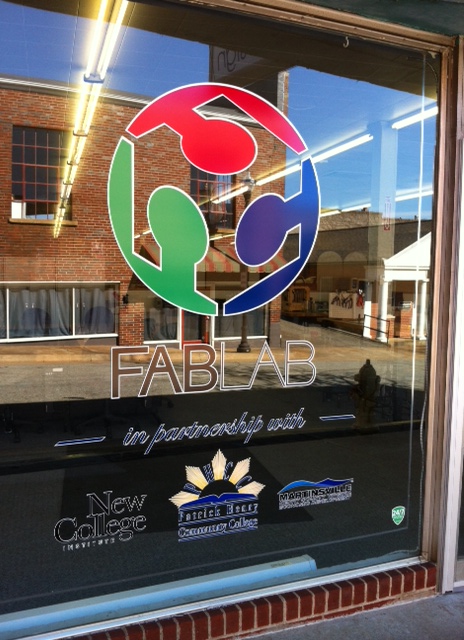
Opened last summer, the Fab Lab in Martinsville is a collaborative project of Patrick Henry Community College, New College Institute and the Martinsville – Henry County Economic Development Corporation. Located in the Southern Virginia Artisan Center, the Fab Lab provides training and equipment to students, businesses and entrepreneurs.

My tour guide was Fab Lab Coordinator and Instructor, Matthew Wade. “To qualify as a true Fab Lab,” Matthew explained, “the facility has to be accessible to the public.” According to the MIT charter, a Fab Lab has to be open to the public for free or in-kind/barter at least part of the time each week. Read more about who/what qualifies as a Fab Lab here.

Most impressively, Matthew assembled the Fab Lab himself. He installed 10 Dell workstations surrounded by whiteboards. Other hardware includes a mid-range 3-D printer, laser engraver, vinyl cutter, CNC plasma cutter, mini-mill, vacuum former, injection molder and welder. Matthew is particularly proud of the two additional MakerBot 3-D printers that were donated to his Fab Lab.

Matthew Wade and his donated MakerBots

Fab Lab Coordinator, Matthew Wade and his donated MakerBots

As fascinating as the physical tour was, I was especially inspired by the ideas and attitudes of both Matthew and colleague, Katie Croft, Coordinator of Experiential Learning at the New College Foundation. Along with many others, they are working in a myriad of ways to create opportunities for area students to thrive and get hired after graduation.

The Fab Lab is providing a platform for learning and innovation for students and adults throughout southern Virginia. The combination of hardware, open source software and Matthew’s experienced guidance, allows his students to rapidly prototype their ideas, a critical step in the innovation process. Or, as Matthew so succinctly put it, “The Fab Lab is enabling them to be digital artisans.”

by Rebecca Cochran

I Chanced Upon “The Rules” Again Yesterday

JohnCage.TheRulesI chanced upon “The Rules” again yesterday. They’re the ones attributed to John Cage, one of the most influential American composers and pedagogues of the 20th century. Many of his works disrupted the way we think about listening. To Cage, music was everywhere and could be made with anything. Chance plays a big role in many of his works.

Although his “Rules for Students and Teachers” were probably penned in the 1960s, I think they can apply to any of us today. Here are a few of my latest reflections on his “RULES.”

His RULE TWO and RULE THREE can just as easily apply to the workplace, as to the classroom. Each of us should pull everything out of our leaders and of our colleagues – and vice versa.

RULE FOUR, RULE SIX and RULE TEN come straight out of any course or book on Design Thinking today. I know it’s an understatement, but Cage was way ahead of his time.

RULE SEVEN is an excellent reminder. We still need to put in the hours, i.e., practice, to become accomplished at anything.

RULE EIGHT is another good reminder, as we probably all fall prey to editing our ideas before we’ve even given them a chance to develop.

RULE NINE is an important one. If we can enjoy ourselves, our work will be that much better.

His HINTS are pretty important, too. I think Cage is reminding us to practice empathy by getting out in the world. He’s urging us to stay curious and gather our dots for connecting later.

What do you think?

by Rebecca Cochran

Can Snow Days Boost Our Creative Capacity?

SnowDayThanks to this year’s unusually disruptive winter weather, we’ve probably all experienced a few days in which our daily routines have been disrupted, as well. If you’re like me, your first reaction to these disruptions is probably negative. This year, however, I decided to rise above that negativity and turn each disruption into an opportunity.

When my first “snow day” of the year appeared, I decided to take the upper hand and proactively change my daily routine. Instead of heading out to my local Starbucks for coffee first thing, I decided to stay off the icy roads and enjoy a cup of tea at home. And, rather than quickly jumping online, I sat at my kitchen table and began mentally mapping out my workday. This led to my grabbing a sketch pad and marker and drawing a “mind map” to help me think through a new client project.

It had been awhile since I had begun a new project offline. With all of our digital tools so close at hand, it can be easy to forget the power of even a crude hand sketch to sort out a process. I ended up sharing my sketches with my client and I think that helped him better visualize our process, as well.

On another snow day, when all of my meetings were cancelled or rescheduled, I decided to flip my routine. Instead of saving my work-related reading for late in the evening, I began that morning with a reading session. Not only were my eyes fresher, but I was also able to apply several fresh, new ideas to my design work immediately that morning. This new routine made me wonder how many fresh, new ideas I “sleep on” and promptly forget following a late night reading session.

These little changes in the workday routine pointed out how valuable it can be to change things up more often. Rather than arbitrarily sticking to a set routine five days a week, we should allow disruption in more often. It just may boost our creative capacity and help us come at a problem from a new perspective.

What do you think?

by Rebecca Cochran