There Is No Wrong Way.

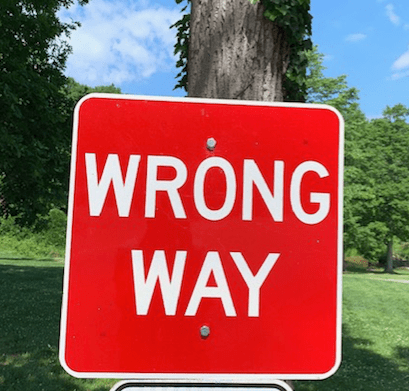
While walking the other day, I spied this sign. Of course, I had to walk towards it. I’ve always had a bit of a contrarian streak within me. Even as a kid, if my sisters were going one way, I went the other —just to see what would happen.

I did my entire walk the “wrong way” that day. I enjoyed crossing paths with other walkers, runners and cyclists and being able to greet them “face-to-face” with a smile or a nod. If I’d been walking the “right way,” I would have missed those human interactions, so important in today’s world.

One of my earlier posts, Walking (and Working) Backwards, came to mind. In that post, I explore some possible advantages to starting a project somewhere in “the middle” or even, at “the end.” There is certainly more than one way to approach a problem, reach a goal or generate a new idea.

On my “wrong way” walk, I recalled yet another of my earlier posts. In it, I recount “The Rules” attributed to John Cage, one of the most influential American composers of the 20th century. Many of his works disrupted the way we think about listening. To Cage, music was everywhere and could be made with anything. Chance plays a big role in many of his works.

Although Cage’s “Rules” are geared towards students and teachers, we can all learn from them. His Rule Six is my favorite. “Nothing is a mistake.” I need to remind myself of this, regularly. There is no “wrong way” to accomplish anything.

I also love the ambiguity of Rule Ten. “We’re breaking all the rules. Even our own rules.” I couldn’t agree more. Whether it pertains to our work or our play, there are no rules. We’re all learning and adapting as we go — especially lately.

There Is No Wrong Way.

What’s So Great About “Great?”


selective photo of gray shark

Photo by GEORGE DESIPRIS on Pexels.com

Yep, that’s right. “Great” is overrated.

For quite awhile, I have been thinking about the possibility of eliminating the word “great” from my vocabulary.

Is “great” a noun? An adjective? An adverb? Or, most likely, all three? What makes it so great to use “great” in a sentence? What is the meaning of “great?”

I always took “great” to mean “large,” as in the phrase, “something greater than myself.” Or, to use examples from the animal world, “great white shark” or “great horned owl.”

Another bothersome point for me is that “great” can refer to things both wonderful, like great art — and devastating, like great destruction during wars or storms.

And, I’m confused why so many of us (myself included) answer “Great!” when asked, “How was your weekend?” Does that one-word response really mean “large?”

It’s almost as if “great” has become an easy catch-all, something we use when we’re too lazy or uncreative to use a descriptive, attention-grabbing word — whether we’re speaking or writing.

What if, instead, when asked by a friend or colleague, “How was your weekend?”, I answered, “Delicious — A friend and I tested several new French recipes on Saturday night and we can’t wait to try more!” Or, “Mind-numbing — I spent the entire weekend working on my tax return!”

And, what if I worked to delete “great,” as an adjective, from my vocabulary?

I might challenge myself to be more descriptive in these instances, as well. Rather than saying, “That was a great concert last night,” I could replace “great” with a more thought-provoking adjective: “That was an emotional concert last evening, don’t you think?” Perhaps this change would open up a real conversation about emotions and feelings around the music for both myself and my concert-mate.

What’s your take on “great? I’m thinking “great” might not be so great any more.

Learning to Unmeasure

UnMeasureMeasurement is really about the past. When we analyze, or measure anything, we’re using the past as the benchmark. How backwards.

Try as we might, we cannot truly measure success. We may think we can. We may attain a certain level of confidence, knowing we’ve reached a prescribed goal. But, truly successful people are smart enough to focus on the future, rather than the past. They use each new success as a launching pad for their next challenge and subsequent success.

Happiness is another unmeasurable. Happiness is intangible and fleeting. It seemingly comes and goes throughout our lives. The wisest among us learn to amortize happiness over the course of life, rather than gauging happiness on a day-to-day basis. Happiness is an art.

Art. Now, there’s an unmeasurable. Art looks, feels and sounds different every time we interact with it. Music and art critics attempt to use words to convey the value of any musical composition, piece of art or literary work, but most of those critics will admit that words are a poor measurement tool. Art is, after all, about feeling, both for the artist and the viewer, listener or consumer of that art. And, how can we measure feelings?

On the business side, is it really possible to measure brand loyalty? Or return on social investment (ROSI)? We can attempt to, but these are almost as elusive to measure as happiness and feelings. And, by the way, brand loyalty and ROSI each include a certain amount of happiness (or unhappiness) and other feelings at their core.

And, what about employee engagement? Do we really need fancy tools to measure that? Engaged employees do positively affect a company’s bottom line (now, that’s a measurement). But, perhaps, employee engagement should be regarded more as a philosophy, rather than something to be measured. When we begin to measure something, we’re then compelled to analyze it to the point that we lose the human element. And, employees want to be treated as humans, not numbers.

That which gets measured matters? Or that which matters is worth measuring?

I say neither. Thankfully, the most important things in life and in business cannot truly be measured. We should all practice the art of unmeasuring once in a while. By doing so, we’ll give ourselves the opportunity to become better listeners, better observers, better friends and better leaders.

What are your thoughts? What are some areas in your personal and/or business life where you can take an unmeasurement approach?