10 Habits for Cultivating Creativity

PhotoAren’t Feeling Particularly Creative These Days? You’re not alone. Many people admit to being so distracted by the avalanche of stimuli demanding their instant and constant attention that they have lost the ability to be creative. Here are ten tips to help get you back on a more creative track:

  1. Do a little something new every day. By challenging yourself to make even a small daily change to the status quo, you’ll unleash some pent-up creativity. Examples: Take a different route to the office or to the coffee shop. Or, order something you’ve never tried before at the cafeteria or lunch counter. Who knows? All this newness could become a creative habit.
  2. Talk to interesting people. Seek out people who challenge you to think about topics that are new to you. Everywhere you go, try to catch the eye of someone who looks interesting or different. Start the conversation yourself. You’ll both benefit.
  3. Take a walk. When in doubt, take a walk. (This one, I learned from my dog). Walking out-of-doors stimulates your brain cells. Just the act of moving around puts a creative new spin on things.
  4. Turn off the TV. As “creative” as some of those sitcoms may be, just sitting and staring at a screen is no exercise for your brain (right side or left).
  5. Listen to Bach. More than any other composer, J.S. Bach’s music is so orderly and exquisitely structured that, just by listening, we get the equivalent of “defragging” the hard drives in our minds. You’ll immediately feel less cluttered. Trust me: it works and you’ll enjoy yourself in the process.
  6. Get away from your computer. Many creative types claim they are creating at their computers. I disagree. I believe creativity happens when we disconnect from technology, at least temporarily. Our computers and accompanying software are simply tools for executing our creative ideas.
  7. Limit yourself. Yep, that’s right. Research shows that when you have too many options (the proverbial blank slate), you can actually hinder creativity. When you begin a creative project, allow yourself just a few tools and make up some ground rules. By boxing yourself in a bit, you’ll force yourself to be more resourceful and creative. Try it!
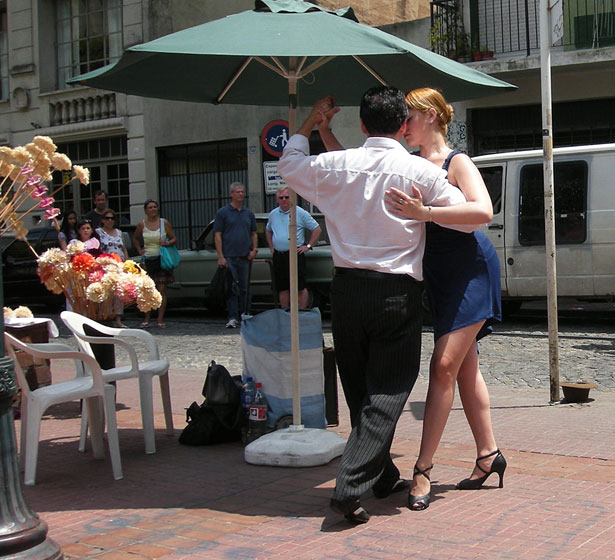
  8. Learn to tango. The true Argentine tango is the most improvisational of all dance styles. After only a couple of lessons with a good instructor, you’ll learn the few basic steps. Then, you and your dance partner can step out at a milonga and create your own dance according to the mood, the music and what you wish to communicate to each other. Argentine tango may be the only dance form that allows for unlimited creativity. There are no wrong moves in tango.
  9. Fall in love. (Note: Can be combined with #8.) According to a study at the University of Amsterdam and recounted in Scientific American, thinking about love triggers global processing, which in turn, promotes creative thinking. According to the researchers, romantic love induces a long-term perspective and allows the mind to make remote and uncommon associations. I’m convinced!
  10. Travel. Akin to the global processing theory of #9, traveling spurs creativity in most of us. Getting away, near or far, stimulates our minds and clears out past clutter. In particular, travel to unusual locales opens up our minds to new ways of looking at things. Supposedly, even just thinking about traveling can get those creative juices flowing. (And, yes, you have my permission to book that trip to Buenos Aires to learn the tango right away!)

Let me know your thoughts. How do you get creative?

by Rebecca Cochran

Details

the Steves

the Steves (Photo credit: blakespot)

by Rebecca Cochran

I saw the new Jobs biopic over the weekend. Whether it was an accurate portrayal of Steve Jobs and the early days of Apple Computer or not, I have to say, I enjoyed it.

Rather than merely taking in the story itself, I challenged myself to notice the details. Surely an important detail was the eye-catchingly simple, yet creative, typeface treatment used in the film titles. Film title design is an art unto itself and Jobs did not fall short here. I’d like to view those titles again.

Another detail that was impossible to ignore was the soundtrack. As a musician myself, music tends to play a major role in any film I view. The Steves spar once or twice in the film about their own personal music preferences. Jobs was a Dylan fan; Woz favored the Beatles.

What stood out for me, though, was the inclusion of Bach in the soundtrack, specifically, the final allegro movement from Bach’s 3rd Brandenburg Concerto. The movement was used as an effective aural backdrop to depict Steve’s enlightenment period after he had dropped out of Reed College.

I felt that the film did a good job of depicting how Steve and one of his college friends had taken some time away to visit India in search of spiritual (and other) enlightenment. These scenes were fast-paced and even a bit hazy. The Bach was performed at a breakneck tempo. It might as well have been notated vivace.

And, it worked for me. Knowing that Bach’s six Brandenburg Concerti were composed in what was probably the happiest and most productive period in Bach’s life, around 1721, I naturally assumed that those months in India represented some of Steve Jobs’ happiest and most productive moments as well.

What details did you notice in the film?

Bach and the Art of Design Thinking

by Rebecca Cochran

Bach.TheArtofDesignThinking

As a musician, I get this question often: “Who is your favorite composer?”

Without hesitation, my answer, for as long as I can remember, has been and forever will be, the great German Baroque composer, Johann Sebastian Bach (1685-1750). For me, there are many reasons why.

Bach’s music moves me like no other. Though challenging to play, his music is filled with pure joy. Understanding the music of Bach is a lifelong pursuit. Never static, each time I hear or play a work by Bach, I hear something new. Bach’s complex layers are constantly revealing themselves to the focused listener or student. My list could go on and on.

In addition to all of these attributes that I attach to Bach, I am convinced that Bach embraced principles of design thinking throughout his musical career. For instance:

Bach combined the analytical with the intuitive. He coupled research (listening and learning from others) with his amazing intuition, moving things forward by imagining new possibilities. Bach was a master at synthesizing past, present and future into nearly everything he wrote. Even his staunchly well-loved B Minor Mass is now believed by many to have been somewhat of an exercise that Bach used to convey his latest musical discoveries.

Bach employed iterative prototyping. Bach would often reuse his own earlier compositions, revising and improving them. He regularly created three or four versions of a single cantata movement. Referred to as parody in the classical music realm, Bach would re-work a movement from a harpsichord concerto into a cantata movement or parody a minuet from a Brandenburg Concerto in a chorale.

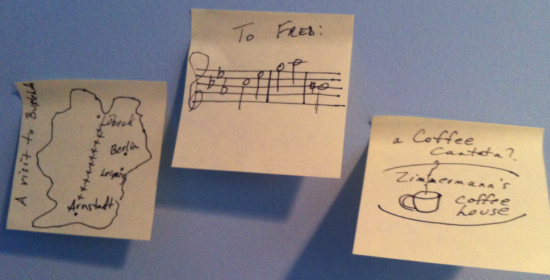
Bach took inspiration from a broad range of experiences and cultures. As a young man of only 20, Bach supposedly walked more than 200 miles from Arnstadt to Lübeck to hear the older, well-established organist and composer, Dietrich Buxtehude, play. Surely, ideas generated by this experience worked themselves into his music. Bach incorporated a variety of music styles from throughout Europe into his works. For example, Bach composed each of the four movements in his Partita for Unaccompanied Flute in a popular dance style of the day with German, Italian, French and English styles all represented.

Bach co-created with others. Bach knew he couldn’t go it alone. He regularly looked to others for inspiration and new ideas. One of his most frequent collaborators was the librettist, Picander. Together, they created a large volume of cantatas and other works including, most notably, the St. Matthew Passion.

Bach regularly embraced constraint as a source of creativity. Probably the most famous example of this is The Musical Offering, inarguably one of Bach’s most striking works. In 1747, upon a visit to the palace of King Frederick the Great of Prussia, the aging Bach was challenged to improvise on a difficult theme given to him by the king, himself a formidable composer. On the spot, Bach improvised a complex fugue at the keyboard. Within two months following his visit, Bach completed The Musical Offering, based entirely on Frederick’s theme. The piece was immediately printed and presented with a dedication to the king.

Bach wrote music for the people. He composed music for the enjoyment of the listener. In Bach’s words, music was “for the recreation of the mind…” Bach’s music can sound simple and elegant, yet beneath the surface exists a highly detailed system of counterpoint and fugue. In addition to his responsibilities as church organist and Kapellmeister (chapel master), Bach directed a Collegium Musicum off and on during his tenure in Leipzig. Actually founded by Telemann, this group of amateur and semi-professional musicians met for informal music making at the coffee-house of Gottfried Zimmermann. Through these performances, Bach was able to hone his skills in writing for a secular audience while giving the people of Leipzig exposure to music outside of the typical church setting. Read A Rollicking Bach Time Is Had By All in today’s New York Times for a modern-day reference to these coffee-house performances.

When we think of early examples of design thinkers, the first person often cited is inventor, Thomas Edison. Yet more than a century before Edison was born, Bach composed a set of 15 keyboard pieces in two contrapuntal parts and termed them inventions. I’m convinced that we can all learn more about design thinking by studying Bach and  listening to anything from his large output of work, be it his cantatas, oratorios, solo partitas, concertos and yes, his inventions.

Let me know what names you’d add to a list of early design thinkers.

This post was originally published in December, 2012.