by Rebecca Cochran
As a musician, I get this question often: “Who is your favorite composer?”
Without hesitation, my answer, for as long as I can remember, has been and forever will be, the great German Baroque composer, Johann Sebastian Bach (1685-1750). For me, there are many reasons why.
Bach’s music moves me like no other. Though challenging to play, his music is filled with pure joy. Understanding the music of Bach is a lifelong pursuit. Never static, each time I hear or play a work by Bach, I hear something new. Bach’s complex layers are constantly revealing themselves to the focused listener or student. My list could go on and on.
In addition to all of these attributes that I attach to Bach, I am convinced that Bach embraced principles of design thinking throughout his musical career. For instance:
Bach combined the analytical with the intuitive. He coupled research (listening and learning from others) with his amazing intuition, moving things forward by imagining new possibilities. Bach was a master at synthesizing past, present and future into nearly everything he wrote. Even his staunchly well-loved B Minor Mass is now believed by many to have been somewhat of an exercise that Bach used to convey his latest musical discoveries.
Bach employed iterative prototyping. Bach would often reuse his own earlier compositions, revising and improving them. He regularly created three or four versions of a single cantata movement. Referred to as parody in the classical music realm, Bach would re-work a movement from a harpsichord concerto into a cantata movement or parody a minuet from a Brandenburg Concerto in a chorale.
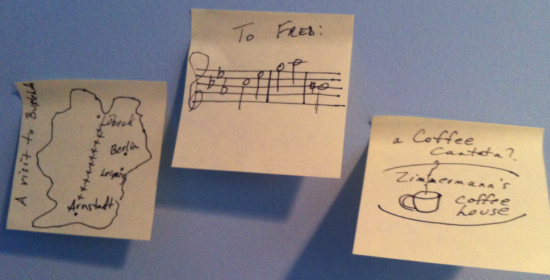
Bach took inspiration from a broad range of experiences and cultures. As a young man of only 20, Bach supposedly walked more than 200 miles from Arnstadt to Lübeck to hear the older, well-established organist and composer, Dietrich Buxtehude, play. Surely, ideas generated by this experience worked themselves into his music. Bach incorporated a variety of music styles from throughout Europe into his works. For example, Bach composed each of the four movements in his Partita for Unaccompanied Flute in a popular dance style of the day with German, Italian, French and English styles all represented.
Bach co-created with others. Bach knew he couldn’t go it alone. He regularly looked to others for inspiration and new ideas. One of his most frequent collaborators was the librettist, Picander. Together, they created a large volume of cantatas and other works including, most notably, the St. Matthew Passion.
Bach regularly embraced constraint as a source of creativity. Probably the most famous example of this is The Musical Offering, inarguably one of Bach’s most striking works. In 1747, upon a visit to the palace of King Frederick the Great of Prussia, the aging Bach was challenged to improvise on a difficult theme given to him by the king, himself a formidable composer. On the spot, Bach improvised a complex fugue at the keyboard. Within two months following his visit, Bach completed The Musical Offering, based entirely on Frederick’s theme. The piece was immediately printed and presented with a dedication to the king.
Bach wrote music for the people. He composed music for the enjoyment of the listener. In Bach’s words, music was “for the recreation of the mind…” Bach’s music can sound simple and elegant, yet beneath the surface exists a highly detailed system of counterpoint and fugue. In addition to his responsibilities as church organist and Kapellmeister (chapel master), Bach directed a Collegium Musicum off and on during his tenure in Leipzig. Actually founded by Telemann, this group of amateur and semi-professional musicians met for informal music making at the coffee-house of Gottfried Zimmermann. Through these performances, Bach was able to hone his skills in writing for a secular audience while giving the people of Leipzig exposure to music outside of the typical church setting. Read A Rollicking Bach Time Is Had By All in today’s New York Times for a modern-day reference to these coffee-house performances.
When we think of early examples of design thinkers, the first person often cited is inventor, Thomas Edison. Yet more than a century before Edison was born, Bach composed a set of 15 keyboard pieces in two contrapuntal parts and termed them inventions. I’m convinced that we can all learn more about design thinking by studying Bach and listening to anything from his large output of work, be it his cantatas, oratorios, solo partitas, concertos and yes, his inventions.
Let me know what names you’d add to a list of early design thinkers.
This post was originally published in December, 2012.


 Cochran Creative Group